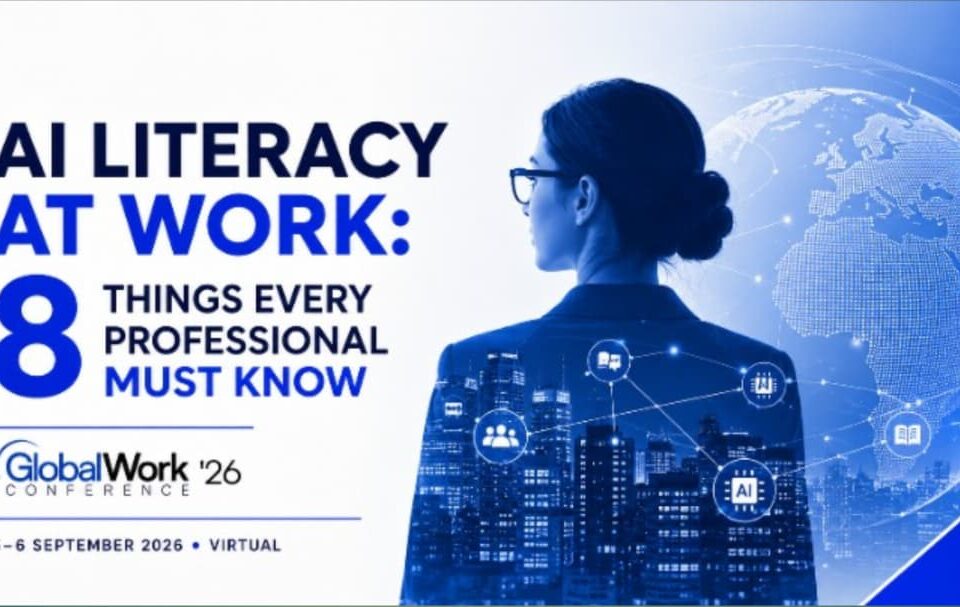
AI Literacy at Work: 8 Things Every Professional Must Know
For a long time, workplace technology followed a familiar pattern: organisations introduced a tool, employees received some training, and everyone gradually became comfortable using it.
Artificial intelligence is moving differently.
Many professionals are already using AI to write emails, summarise documents, develop presentations, analyse information, generate ideas and complete administrative tasks. In some organisations, this adoption is happening before clear policies, training or quality-control processes have been established.
That creates both opportunity and risk.
An employee can use AI to complete a task faster. But if the information entered is confidential, the output is inaccurate or the recommendation disadvantages someone unfairly, speed quickly becomes a liability.
This is why AI literacy is becoming one of the most important workplace capabilities of 2026.
The OECD describes AI literacy as the ability to understand, use and critically assess AI—not simply operate an AI tool. Its July 2026 research argues that most workers will need this broader literacy rather than advanced technical expertise. OECD, Skills in the AI Age
In other words, you do not need to become an AI engineer. But you do need to understand what AI can do, where it can fail and how to remain responsible for the work it helps you produce.
Here are eight things every professional should know.
1. AI can produce confident answers without knowing they are correct
Generative AI systems produce responses by identifying patterns and predicting useful outputs. They can write with remarkable confidence even when the underlying information is incomplete, outdated or wrong.
This means polished language should never be confused with verified truth.
Imagine asking an AI tool to prepare a market analysis. It may produce convincing statistics, name reports that do not exist or combine information from different periods without making the distinction clear. If you copy that analysis into a board presentation, you remain responsible for the error.
An AI-literate professional checks:
- Important facts and statistics
- Names, dates and quotations
- Legal, financial and medical claims
- Links and references
- Calculations and data interpretations
- Whether the information is current
The European Commission specifically identifies inaccurate or fabricated output, often called hallucination as a risk employees should understand when using tools such as ChatGPT for workplace writing and translation. European Commission, AI Literacy Questions and Answers
Use AI to accelerate your first draft, research plan or thinking process. Do not allow it to become your final authority.
2. The quality of your instruction affects the usefulness of the response
Many disappointing AI results begin with an unclear request.
“Write a report about our customers” gives the system very little direction. It does not explain the audience, objective, required evidence, time period, tone or decision the report is intended to support.
A stronger instruction might explain:
- The task to be completed
- The intended audience
- The relevant background
- The required format and length
- The evidence that should be used
- The constraints that must be respected
- The criteria for a successful response
For example:
Summarise the attached customer-feedback themes for the senior management team. Identify the three most frequent complaints, distinguish evidence from inference, and recommend two actions. Do not invent figures or fill gaps in the data.
This is not about discovering a magical collection of words. It is about defining the problem clearly.
Prompting is increasingly useful, but problem definition is the deeper skill. A professional who does not understand the task will struggle to judge whether an AI-generated answer solves it.
3. Confidential and personal information requires protection
Before entering information into an AI tool, pause and ask:
Am I authorised to share this information here?
A convenient tool is not automatically an approved workplace tool. Its terms, privacy controls and data-handling arrangements may differ from those of an organisation’s authorised systems.
Avoid entering information such as:
- Customer or employee personal details
- Passwords or access credentials
- Unpublished financial information
- Confidential contracts
- Sensitive health information
- Proprietary business strategies
- Identifiable recruitment or performance records
This matters particularly when AI processes personal data. The UK Information Commissioner’s Office explains that UK data-protection requirements can apply when personal data is used to train, test or deploy an AI system. It also stresses the need for appropriate security against unauthorised processing, accidental loss or damage. UK Information Commissioner’s Office
If you are uncertain, remove identifying details, use fictional or anonymised information, consult your organisation’s policy, or choose an approved internal system.
The safest question is not merely, “Can this AI tool help me?” It is, “Can I use it for this specific task with this specific information?”
4. AI output can contain bias
AI systems learn patterns from data and human-created material. Those patterns may reflect historical inequality, incomplete representation or assumptions embedded in previous decisions.
Bias can become especially serious when AI is used to support recruitment, lending, employee evaluation, education, healthcare or access to public services.
Suppose an AI tool helps shortlist job applicants. A professional should not assume the recommendations are neutral simply because they came from software. The system may be influenced by biased historical data, inappropriate criteria or proxy variables that disadvantage particular groups.
The ICO warns that using personal data in ways that produce unjust discrimination can breach the fairness principle of data-protection law. ICO guidance on fairness, bias and discrimination
Ask:
- Who is represented in the data?
- Who might be overlooked?
- Could this recommendation affect one group differently?
- Are the criteria relevant and defensible?
- Can a person challenge the outcome?
- Has a qualified human reviewed the decision?
AI literacy requires more than spotting factual errors. It also requires examining who could be affected by an apparently efficient decision.
5. Human oversight must be meaningful
“Human in the loop” can become an empty phrase if the person reviewing the output lacks the time, knowledge or authority to question it.
Meaningful oversight means the reviewer understands:
- What the system was asked to do
- What information it used
- Its known limitations
- The potential consequences of an error
- When to reject or escalate the output
- Who is accountable for the final decision
The US National Institute of Standards and Technology recommends integrating AI risk into wider organisational processes covering privacy, security and accountability. Its framework organises responsible AI management around four functions: govern, map, measure and manage. NIST AI Risk Management Framework
For everyday professionals, the principle is straightforward: never approve an AI-supported decision merely because the system produced it.
Your judgement is not an optional extra added after automation. It is part of the control that makes responsible use possible.
6. Not every task should be delegated to AI
AI is useful for tasks involving speed, structure, comparison, summarisation and idea generation. It is less suitable when the work requires deep personal knowledge, emotional sensitivity, confidential judgement or accountability for serious consequences.
Before using it, assess the task.
Lower-risk uses may include:
- Brainstorming alternative headlines
- Creating a first-draft meeting agenda
- Reorganising notes
- Suggesting spreadsheet formulas
- Summarising non-confidential text
- Generating practice questions
Higher-risk uses may include:
- Deciding who should be hired or dismissed
- Interpreting a contract without professional review
- Assessing an employee’s health
- Making financial recommendations to a client
- Handling safeguarding concerns
- Communicating a serious disciplinary decision
The answer is not necessarily to avoid AI completely. It is to match the level of oversight and expertise to the possible harm.
A five-minute shortcut is not valuable if correcting the consequences takes five weeks.
7. Responsible use sometimes requires transparency
There are situations in which people should know that AI contributed to content, communication or a decision affecting them.
The appropriate level of disclosure depends on the context. Using AI to improve the grammar of an internal note is different from generating a public expert opinion, academic submission or assessment of a job candidate.
Ask yourself:
- Would the audience reasonably expect this to be entirely human-created?
- Could AI involvement affect their trust or decision?
- Does my employer, institution or client require disclosure?
- Am I presenting AI-generated analysis as my own expertise?
- Can I explain how the result was produced and checked?
Transparency should not become a meaningless label added to everything. It should help people understand material AI involvement, especially where credibility, rights or significant decisions are concerned.
8. AI literacy is a continuing practice – not a one-off course
AI tools, workplace uses and regulations continue to change. A training session completed last year may not address the system your team introduces next month.
The European Union has now made this issue more concrete. Article 4 of the EU AI Act requires organisations providing or deploying AI systems to support the development of AI literacy among relevant staff and others working on their behalf. The requirement has applied since February 2025, with national supervision and enforcement beginning in August 2026. Recent amendments removed the idea that every organisation must achieve a prescribed “sufficient” level, but the obligation to support AI literacy remains. European Commission, 27 July 2026
The Commission also makes clear that there is no single mandatory training format. Appropriate learning depends on the people involved, the technology being used, its purpose and its level of risk.
Although the AI Act does not automatically govern every organisation everywhere, its reach can include providers and users outside the EU when their AI systems are placed on the EU market, used there or affect people located there. This matters to internationally connected organisations and professionals in the UK, Nigeria and beyond.
A useful workplace AI-literacy programme should therefore evolve through:
- Identifying the AI systems people actually use
- Understanding the tasks and risks connected to them
- Setting clear acceptable-use rules
- Training people according to their roles
- Creating routes for questions and incident reporting
- Reviewing practices as technology and regulations change
- Keeping a record of guidance and training provided
The goal is not to create fear around AI. It is to build the confidence to use it intelligently.
A simple test before using AI at work
Before submitting your next prompt, use these five questions:
- Purpose: Is AI appropriate for this task?
- Permission: Am I authorised to use this tool and information?
- Proof: How will I verify the output?
- People: Who could be affected if it is wrong or biased?
- Ownership: Who is accountable for the final result?
If you cannot answer those questions, pause before proceeding.
The real advantage is responsible capability
The AI economy will not reward people simply for using the latest tool. As access becomes widespread, advantage will come from using AI with context, judgement and purpose.
AI literacy means knowing how to ask better questions, protect information, challenge unreliable answers, recognise risks and take responsibility for the result.
It is both a career skill and a leadership responsibility.
This is one of the vital conversations we will continue at the Global Work Conference 2026, themed “Unlocking Global Opportunities in the AI Economy.”
Join us virtually on Saturday, 5 September 2026, as professionals, entrepreneurs, students, leaders and career changers explore AI, global careers, digital skills, entrepreneurship and the future of work.
Day 1 is free, but registration is required. Day 2, on Sunday, 6 September, is an optional paid masterclass.
Register for the free Day 1 conference
AI will continue to become more capable. Our responsibility is to become more thoughtful about how we use it.
Frequently asked questions
What is AI literacy?
AI literacy is the ability to understand, use and critically assess artificial intelligence. It includes recognising AI’s capabilities and limitations, checking outputs, protecting information and understanding its potential effects on people.
Do I need technical or coding skills to become AI literate?
No. Most professionals need practical knowledge that helps them use AI effectively and responsibly. Advanced programming and model-development skills are required only for certain specialised roles.
Is using ChatGPT the same as being AI literate?
No. Operating an AI tool is only one part of AI literacy. A genuinely AI-literate person can assess whether the tool is appropriate, provide useful context, verify its response and recognise privacy, accuracy and fairness risks.
Can I enter workplace documents into an AI tool?
Only when you are authorised to use that tool and share the information it contains. Check your organisation’s policy and avoid entering personal, confidential or commercially sensitive information into unapproved systems.
Does the EU AI Act apply in the UK or Nigeria?
It can apply in certain cross-border circumstances, including when an AI system is placed on the EU market, used in the EU or affects people located there. Organisations should obtain appropriate legal advice about their specific activities.
Suggested articles to read further
- 7 Skills That Will Keep You Valuable in the AI Economy
- A future article on how to create an AI policy for a small organisation
- A future article on protecting your professional voice when using generative AI
- A future guide to building a 30-day AI learning plan
- The GWC 2026 schedule of events and registration page






3 Comments
This is a very good read. Thank you for sharing
You are absolutely correct. Quite an interesting read.